Here’s a conversation we have almost every summer in Madison Heights.
A homeowner calls about a three-year-old air conditioner. It cools the house fast — almost too fast — but the place feels clammy. The wood floors are cupping a little. There’s condensation on the windows in the morning. The unit kicks on, roars for six or seven minutes, shuts off, and does it again twenty minutes later, all day long. And the electric bill went up after the new install, not down.
Almost every time, it’s the same root cause: the system is too big.
It’s the most expensive mistake in residential HVAC, and it’s completely avoidable. Here’s what actually determines the right size — and why “bigger is better” is dead wrong when it comes to air conditioning.
What “Size” Actually Means
Air conditioner size has nothing to do with physical dimensions. It’s measured in tons — a leftover term from the days of ice houses. One ton equals 12,000 BTUs of heat removal per hour. Residential systems in Metro Detroit typically run from 1.5 to 5 tons.
The job of that system isn’t just to lower the temperature. It has two jobs, and the second one is the one people forget:
- Sensible cooling — dropping the air temperature
- Latent cooling — pulling moisture out of the air
Michigan summers are humid. Great Lakes humidity is exactly why your July afternoons feel worse than the thermometer suggests. And here’s the catch: an air conditioner can only dehumidify while it’s running. Moisture condenses on the cold evaporator coil over time — it takes a good 10 to 15 minutes of continuous runtime before meaningful dehumidification even starts.
That single fact is why oversizing backfires.

What Is a Manual J Load Calculation?
Manual J is the industry-standard method — published by the Air Conditioning Contractors of America — for calculating exactly how much heat a specific house gains on a hot day. Not a house like yours. Your house.
Think of it as a heat budget. A technician measures everything that lets heat in or keeps it out, and adds it all up:
- Square footage and ceiling height — volume of air, not just floor area
- Window count, size, orientation, and glazing — a wall of west-facing single-pane windows is a heat problem; the same wall in double-pane low-E is not
- Insulation levels in walls, attic, and floors — this is the big one in older Madison Heights homes
- Air infiltration — how leaky the building envelope is around doors, windows, rim joists, and attic penetrations
- Duct location and condition — ducts in an unconditioned attic lose serious capacity
- Roof color, shading, and tree cover
- Local design conditions — for our area, roughly a 88–90°F summer design temperature with high humidity
- Internal heat gains — occupants, appliances, lighting, that home office full of equipment
- Room-by-room breakdown — so the airflow gets distributed correctly, not just the total tonnage
What Manual J is not is a rule of thumb. You’ve probably heard “one ton per 500 square feet” or “600 square feet per ton.” Those shortcuts ignore insulation, windows, and air sealing entirely — which means they’ll size the same unit for a drafty 1952 bungalow and a fully renovated version of that identical house. One of those two answers is badly wrong.
If a contractor quotes you a tonnage after walking through your house for four minutes with a tape measure, you’re getting a guess. A proper load calculation takes real measurement time and produces a printed report. Ask to see it.
Why Oversizing Is Worse Than Undersizing
An undersized AC struggles on the hottest days. That’s obvious, and it’s a problem. But an oversized AC creates problems that are less obvious and far more expensive.
It Short-Cycles
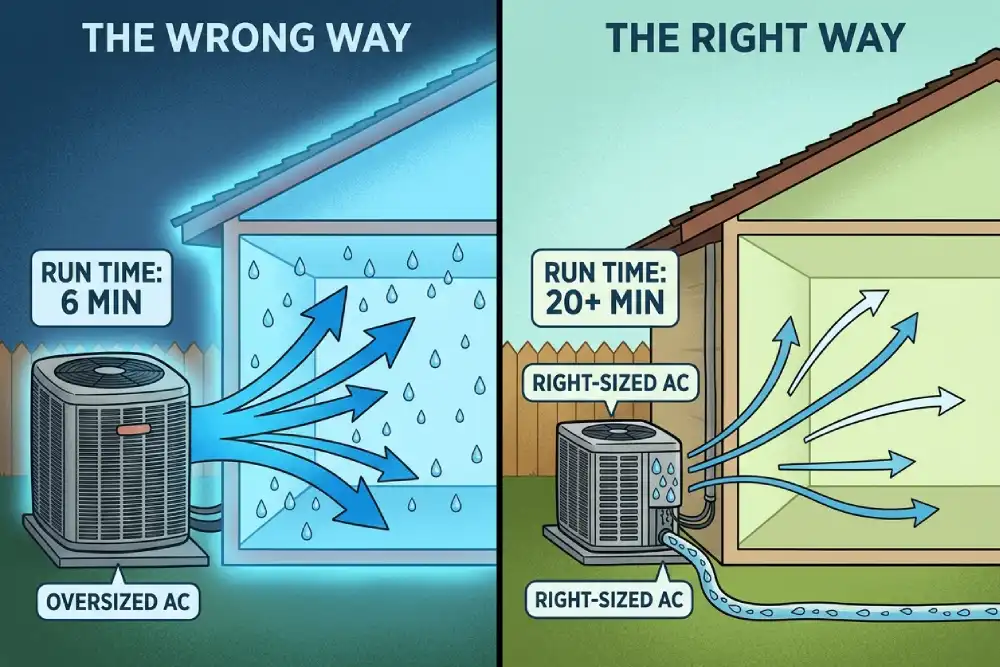
An oversized unit hits the thermostat setpoint fast — sometimes in five or six minutes — and shuts off. Then the house warms slightly, and it fires up again. Twenty, thirty, forty short cycles a day instead of a handful of long, steady ones.
Your House Stays Humid
This is the big one, and it’s what drives most of the callbacks. Those six-minute cycles never run long enough to wring water out of the air. The thermostat reads 72, so the system is technically “working” — but the relative humidity is sitting at 60% or higher and the house feels cold and damp instead of cool and dry. That’s the clammy basement feeling, the musty smell, the sticky-skin sensation in an “over-cooled” room.
Sustained indoor humidity also invites mold growth, dust mites, and warped hardwood.
It Wears Out Years Early
The hardest work an AC compressor ever does is starting up. Every cycle means an inrush of current, mechanical stress, and heat. Triple the number of starts per day and you compress a 15-year equipment life into 8 or 10. Compressors, contactors, and capacitors all fail sooner.
It Costs More to Run
Startup draws several times the current of steady-state running. A system that’s constantly starting burns more electricity than one that runs longer and gentler — even though the oversized unit is “off” more of the time.
Comfort Gets Worse, Not Better
Short bursts of high-volume air don’t circulate well through a house. You get cold spots near the supply registers and warm, stagnant rooms at the far end of the duct run. Temperature swings between cycles are bigger and more noticeable.
You Paid More Up Front
Larger equipment costs more, and it may require larger line sets and duct modifications. You are literally paying extra for a worse result.
The Madison Heights Wrinkle
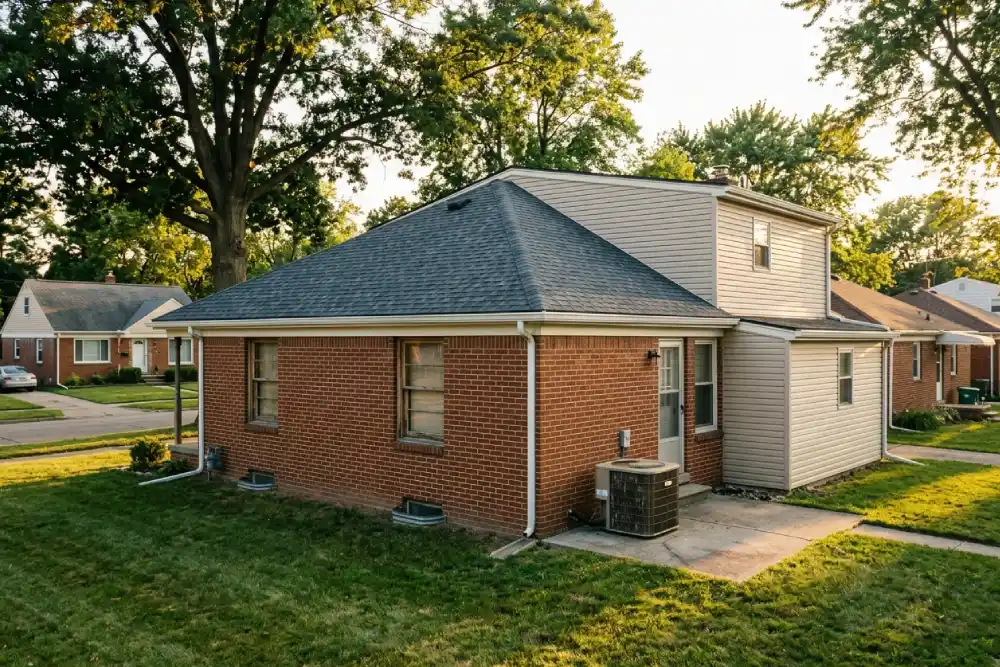
A lot of the housing stock around Madison Heights, Hazel Park, Ferndale, and Royal Oak dates to the post-war building boom. Those homes have been improved unevenly over seventy years — new windows here, blown-in attic insulation there, a finished basement, a rear addition, a re-sided exterior.
That matters enormously. If your home has been meaningfully air-sealed, insulated, or re-windowed since the original system went in, your correct AC size is probably smaller than what’s sitting outside right now. Replacing a 25-year-old 4-ton unit with a new 4-ton unit — “matching what was there” — is one of the most common ways homes end up oversized.
It’s the easiest sale for a contractor to make and the worst outcome for the homeowner.
What to Ask Before You Sign
Use these five questions to separate a real HVAC contractor from a box-swapper:
- “Will you perform a Manual J load calculation, and can I see the report?” The answer should be yes without hesitation.
- “Did you evaluate my ductwork?” Manual D covers duct sizing. Perfect equipment on undersized ducts still underperforms.
- “How did my insulation and windows factor into the number?” They should be able to tell you specifically.
- “Why this size and not one step up or down?” A good tech will explain the tradeoff in plain language.
- “Would a variable-speed or two-stage system help my humidity?” For humid Michigan summers, modulating equipment runs longer at lower capacity — which is exactly what good dehumidification requires. It costs more up front and is often worth it.
If a room or an addition is the real problem rather than the whole house, a ductless mini-split may solve it for far less than upsizing the central system.
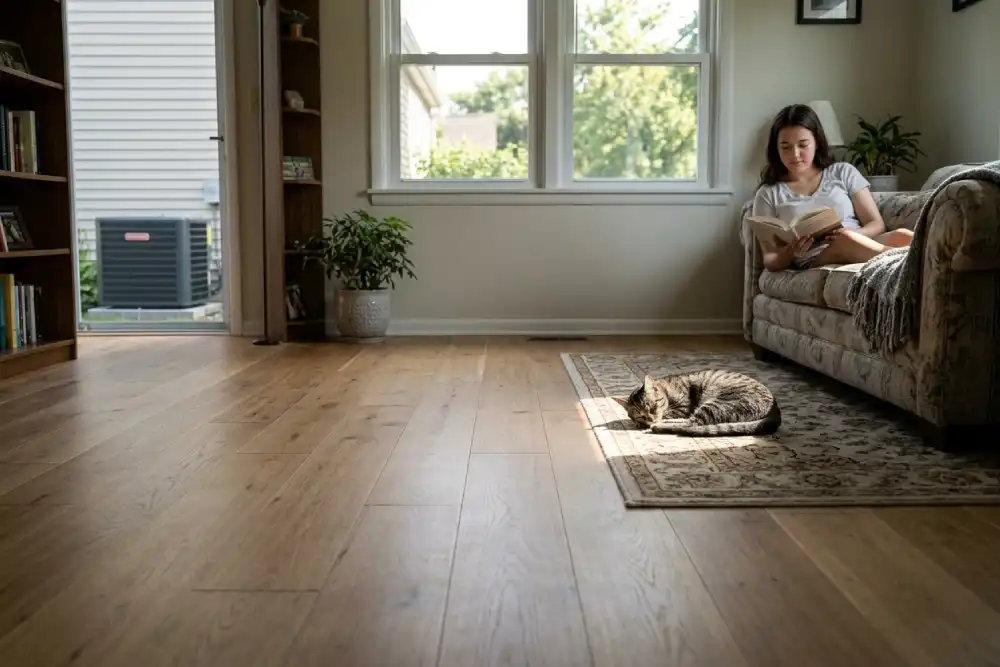
Right-Sized Beats Oversized, Every Time
The goal isn’t the biggest unit your budget allows. It’s the unit that runs long, steady cycles on a hot August afternoon — quietly pulling both heat and moisture out of your house, holding an even temperature room to room, and lasting fifteen-plus years while it does it.
Getting that right starts with a real load calculation, not a rule of thumb.
Get a Free, Properly Sized Estimate
Air Clinic Heating & Cooling is a family-owned HVAC contractor based right here in Madison Heights, serving Troy, Royal Oak, Birmingham, Sterling Heights, Ferndale, Clawson, Berkley, Huntington Woods, Beverly Hills, and Bloomfield. Every job is performed by licensed, insured Michigan technicians — no sub-contractors, ever.
- Free estimates on installation and replacement
- $500 off AC replacement — a strong time to upgrade if your system is 15+ years old, uses R-22, or has needed repeat repairs
- Flexible financing available
- 24/7 emergency service
Call 248-250-4679 or request your free estimate online. We’ll size it right the first time.
Not sure whether to repair or replace? Start here: Repair vs. Replace — How to Know It’s Time for a New AC Installation.