There is a specific kind of panic that hits when the furnace goes quiet on a 9-degree January night in Madison Heights — or when the AC gives up during a humid July stretch and the house climbs past 85 by dinnertime. Your first instinct is to call someone. That’s often the right call. But a surprising share of “my system is dead” calls turn out to be something a homeowner can fix in ten minutes with no tools and no risk.
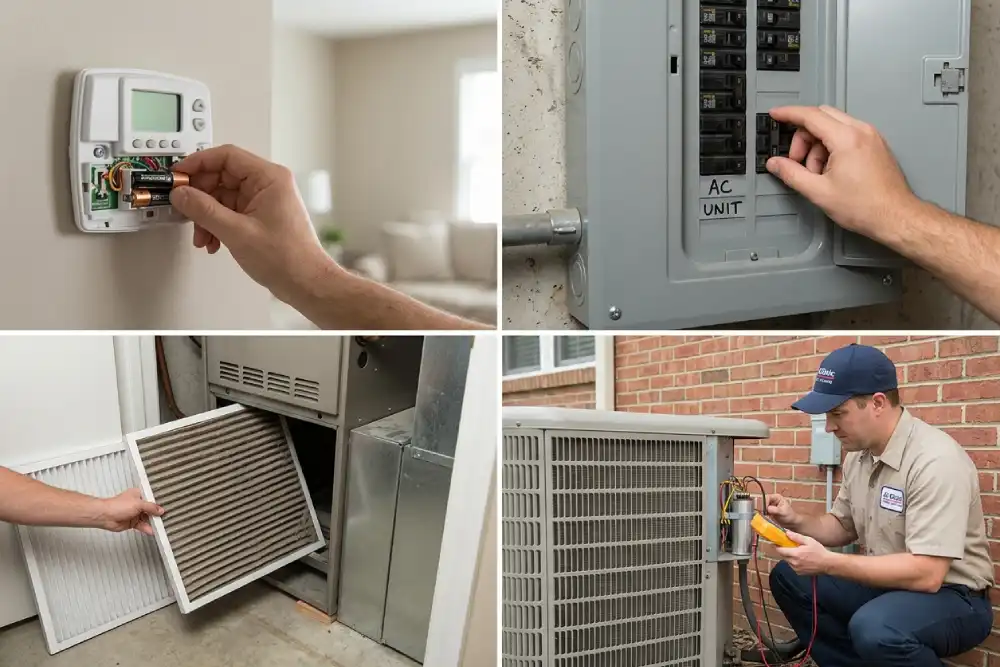
Here are the five failures we see most often across Madison Heights, Royal Oak, Troy, and the rest of Metro Detroit — the three you can safely handle yourself, and the two that need a licensed technician holding the screwdriver.
1. The Thermostat (Fix It Yourself)
This is the number one reason we get called out for a “dead” system, and it is the cheapest one to rule out.
A battery-powered thermostat with dying batteries doesn’t always shut off cleanly. Sometimes the screen dims, sometimes it freezes on the last reading, and sometimes it looks perfectly normal but stops sending the signal to your furnace or AC. The system isn’t broken — it just never got the message.
What to check, in order:
- Swap the batteries. Pop the faceplate off the wall plate, replace with fresh AA or AAA batteries (check what’s in there), and give it a minute to boot up.
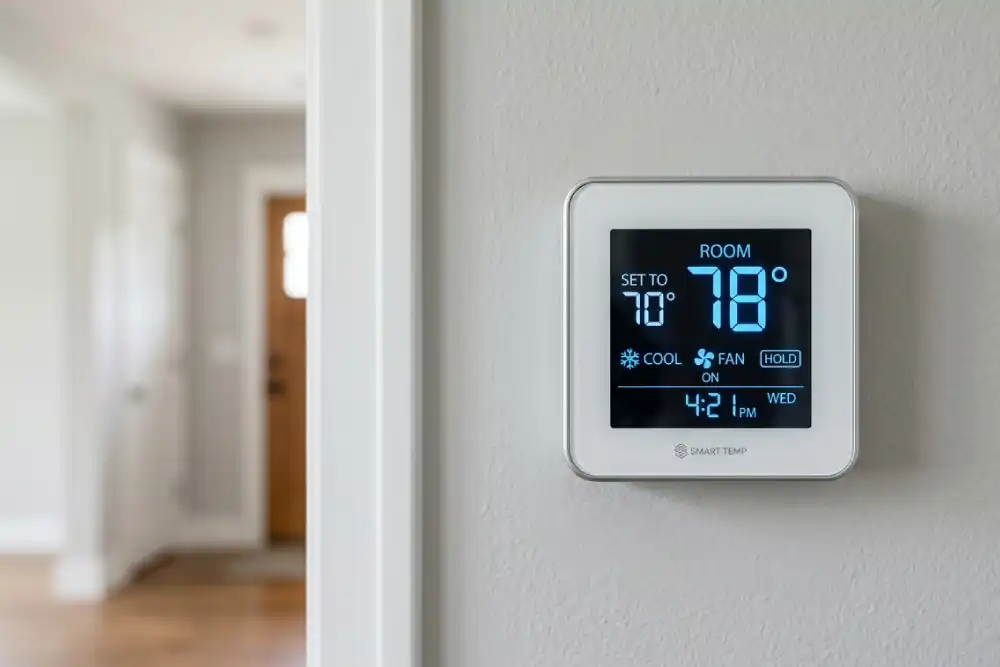
- Confirm the mode. Make sure it’s set to COOL in summer or HEAT in winter — not AUTO, not OFF. This sounds obvious. It catches people every single season, especially after a spring or fall changeover.
- Set the temperature 5 degrees past the room temp. If it’s 78 in the house, set it to 70. A 1-degree gap may not be enough to trigger a call for cooling.
- Check the schedule. Smart and programmable thermostats can quietly hold an “away” or “eco” setting after a schedule change, a Wi-Fi update, or a power blip.
If the screen is completely blank after a battery swap on a hardwired thermostat, move on to reason #2 — you may have lost power to the whole system.
2. A Tripped Breaker or Flipped Service Switch (Fix It Yourself — Once)
Michigan storms knock power around, and both your furnace and your outdoor AC unit are on their own circuits. A surge, a brownout, or a temporary overload can trip a breaker and leave the rest of your house running normally while the HVAC sits dark.
Three switches to check:
- The breaker panel. Look for a breaker that’s sitting between ON and OFF, or one that’s slightly out of line with its neighbors. To reset it, push it firmly all the way to OFF first, then back to ON. Halfway resets don’t work.
- The furnace service switch. It looks exactly like a light switch, usually mounted on or near the furnace itself in the basement or utility closet. It gets bumped during laundry day, storage shuffling, or by anyone working near it.
- The outdoor disconnect box. Mounted on the wall next to your condenser unit. Make sure the pull-out or lever is fully seated.
The one-reset rule: If the breaker trips again, stop. Do not keep resetting it. A breaker that trips repeatedly is doing its job — it’s telling you there’s a short, a failing capacitor, a seizing compressor, or a motor pulling too much current. Resetting it over and over can turn a $200 part into a burned-out compressor. That’s a call to a licensed tech, not a second attempt.
3. A Clogged Filter or Blocked Airflow (Fix It Yourself)
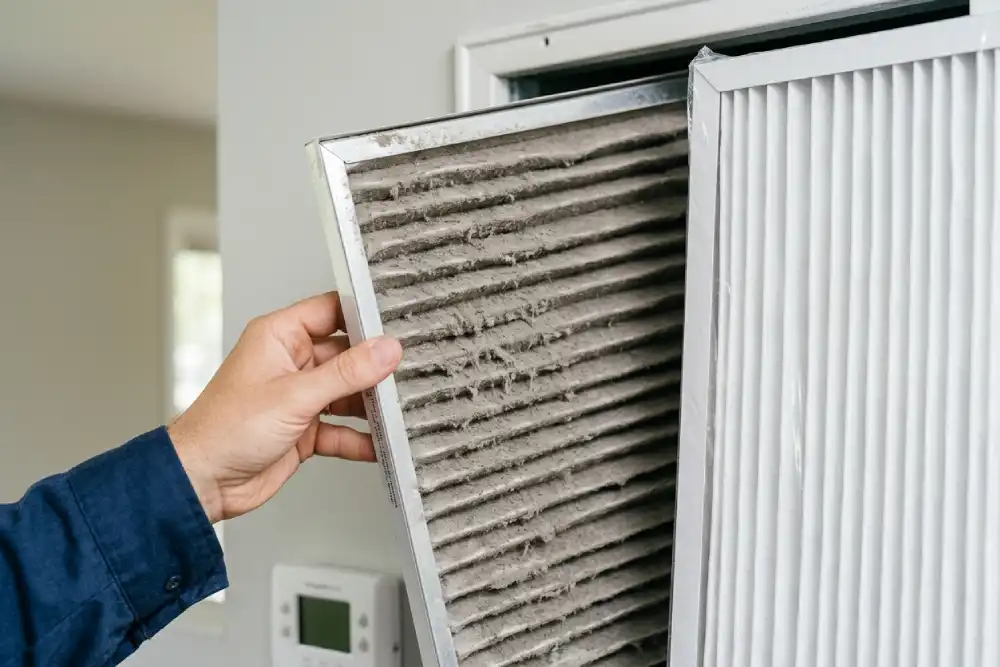
A filter that hasn’t been changed since last season chokes your system. In heating mode, restricted airflow overheats the heat exchanger and trips the high-limit switch, which shuts the furnace down for safety – often in a frustrating cycle where it runs for a few minutes and then quits. In cooling mode, the same restriction freezes the evaporator coil into a solid block of ice, and you get a running system blowing lukewarm air.
What to do:
- Replace the filter. Match the size printed on the frame, and note the airflow arrow — it points toward the furnace. In most Madison Heights homes, every 60 to 90 days is right; every 30 if you have pets or allergies.
- If you find ice on the coil or the refrigerant line, shut the system off at the thermostat and run the fan only. Let it thaw fully — that can take a few hours. Then replace the filter and restart. If it ices up again, the problem is refrigerant or airflow-related and needs a tech.
- Open the vents. Closing registers in unused rooms doesn’t save money; it raises static pressure and strains the blower.
- Clear the outdoor unit. Give the condenser two feet of clearance on all sides. Grass clippings, leaves, cottonwood fluff, and that stack of patio furniture all restrict the heat rejection your AC depends on.
- Check the condensate drain. A clogged drain line trips the float switch and shuts the AC off completely. If the pan under your indoor unit is full of standing water, that’s your answer.
Now the Two You Should Not Touch
4. A Failed Capacitor, Contactor, or Blower Motor (Call a Pro)
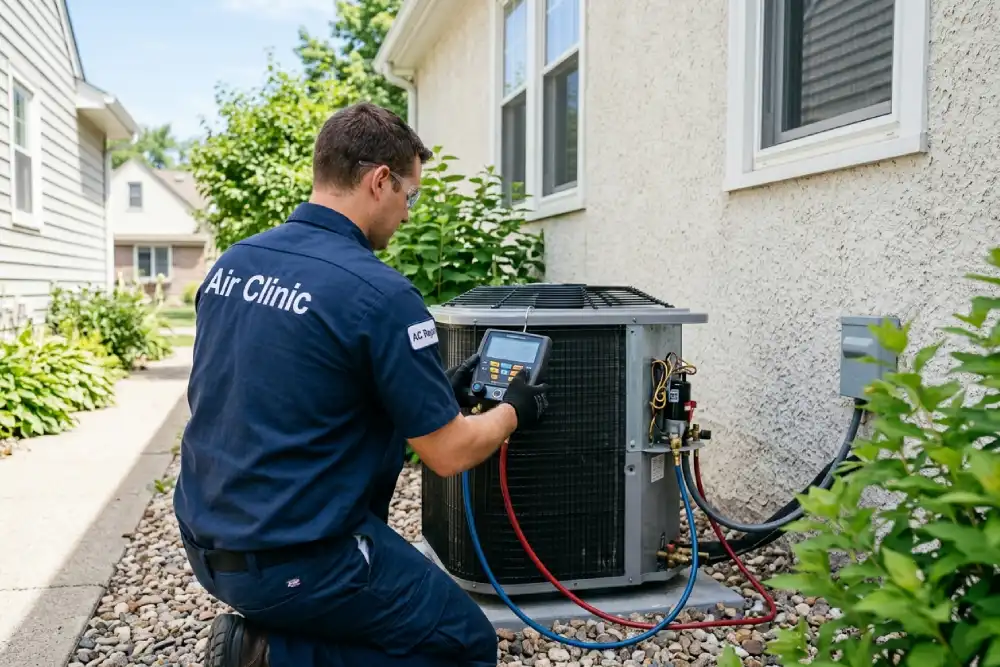
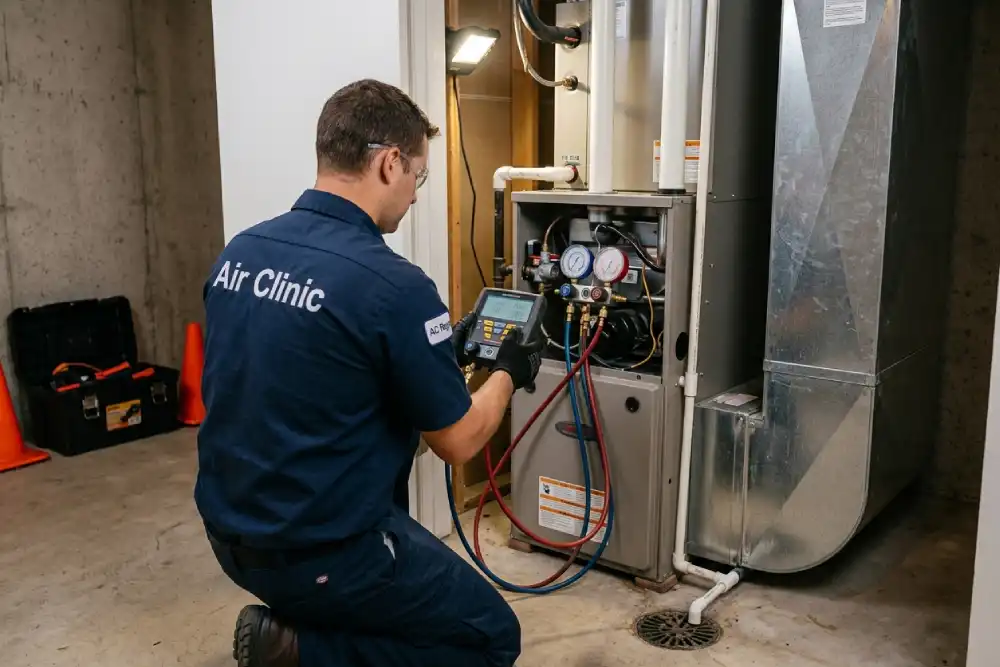
If your AC hums but the fan won’t spin, or the outdoor unit clicks and does nothing, you’re very likely looking at a failed start/run capacitor or a pitted contactor. These are common, relatively inexpensive parts — and they’re also the reason we tell homeowners to stay out of the electrical compartment.
A capacitor stores a lethal electrical charge even after the power is off. It does not discharge on its own timeline, and it does not care that the breaker is flipped. Every year, someone finds a YouTube video, opens the access panel, and touches the terminals. Please don’t be that person. A technician can discharge it safely, test it with a meter, and swap it in under an hour.
The same goes for a blower motor that’s screeching, grinding, or humming without moving air. Bearings, wheel balance, and motor windings are diagnostic work, not guesswork.
5. Gas, Ignition, or Heat Exchanger Problems (Call a Pro Immediately)
If your furnace is trying to light and failing — you hear the inducer motor spin up, a click, and then nothing, repeating three or four times before it locks out — you may have a failed igniter, a dirty flame sensor, a bad pressure switch, or a gas supply issue. Some of those are quick fixes for a technician. None of them are homeowner projects.
Stop and call for emergency service right away if you notice:
- The smell of gas, or a rotten-egg odor anywhere near the furnace
- A yellow or flickering burner flame instead of a steady blue one
- Soot or scorch marks around the furnace cabinet
- A carbon monoxide detector alarm
- Headaches, dizziness, or nausea that improve when you leave the house
If you smell gas, leave the house first and call from outside. Cracked heat exchangers and combustion problems can put carbon monoxide into your living space, and CO is not something to troubleshoot on your own.
The Honest Rule of Thumb
If the fix involves a battery, a switch, or a filter — try it. If it involves refrigerant, gas, or anything behind an electrical access panel — call.
Working through the three DIY checks above takes about fifteen minutes and solves a real percentage of no-heat and no-cool calls. If you’ve done all three and the system still won’t run, you’ve done exactly the right thing: you’ve saved yourself a service call on the easy stuff and you’ve given your technician a head start on the hard stuff.
When You Need Help in Madison Heights
Air Clinic Heating & Cooling has been the trusted name in HVAC across Madison Heights, Troy, Royal Oak, Birmingham, Ferndale, Sterling Heights, Clawson, Berkley, Huntington Woods, Beverly Hills, and Bloomfield. We’re family owned, every job is performed by licensed and insured Michigan technicians, and we never use sub-contractors.
- 24/7 emergency service — because furnaces don’t fail during business hours
- $70 diagnostic fee — flat and up front, no surprises
- Free estimates on installation and replacement
Call 248-250-4679 or request service online. We’ll treat you like family.
Want to avoid the emergency call altogether? Most of the failures on this list get caught during a routine HVAC inspection and tune-up — once in spring for cooling, once in fall for heat.